Ideal Translational Velocity Source
R2026bIdeal velocity source in mechanical translational systems
Ideal Translational Velocity Source block

To add a block to a model, double-click the canvas and start typing the block name. Then, select the block from the list.
Libraries:
Simscape /
Foundation Library /
Mechanical /
Mechanical Sources
Description
The Ideal Translational Velocity Source block represents an ideal source of velocity that generates velocity differential at its terminals proportional to the input physical signal. The source is ideal in a sense that it is assumed to be powerful enough to maintain specified velocity regardless of the force exerted on the system.
Connections R and C are mechanical translational conserving ports. Port S is a physical signal port, through which the control signal that drives the source is applied. The relative velocity (velocity differential) across the source is directly proportional to the signal at the control port S. The entire variety of Simulink® signal sources can be used to generate the desired velocity variation profile.
The block positive direction is from port R to port C. This means that the velocity is measured as v = vR – vC, where vR, vC are the absolute velocities at ports R and C, respectively, and force through the source is negative if it is acts from C to R. The power generated by the source is negative if the source delivers energy to port R.
Examples
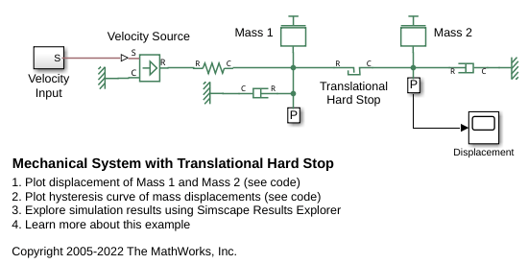
Mechanical System with Translational Hard Stop
Two masses connected by a hard stop. Mass 1 is driven by an Ideal Velocity Source. As the velocity input changes direction, Mass 2 will stay at rest until Mass 1 reaches the other end of the backlash modeled by the Translational Hard Stop. Plotting the displacement of Mass 2 against the displacement of the Mass 1 produces a typical hysteresis curve.
Ports
Input
Conserving
Programmatic Use: Add Block
To add the block programmatically, use the add_block function with one of these library block paths as the source.
"fl_lib/Mechanical/Mechanical Sources/Ideal Translational Velocity Source"
Example: add_block("fl_lib/Mechanical/Mechanical Sources/Ideal Translational Velocity Source","myModel/myBlock",MakeNameUnique="on")
For information about programmatic access to individual block parameters, see the Programmatic Use section of parameter descriptions on this page.
Extended Capabilities
Version History
Introduced in R2007a

