rt60
R2026bDescription
rtsummary = rt60(rir,fs)
rtsummary = rt60(rir,fs,Name=Value)
rt60(___) without any output arguments plots the
reverberation time metrics for each octave band. You can select the octave bands in the plot
to see the impulse response power and energy decay curve in each band.
Examples
Read in a room impulse response for the interior of a church from a file.
[rir,fs] = audioread("ChurchImpulseResponse-16-44p1-mono-5secs.wav");Call rt60 with the impulse response to get a table containing the RT-60 metrics for each octave center frequency.
metrics = rt60(rir,fs)
metrics = 6×11 table
    CenterFrequencies     EDT       T20       T30       Topt              DegreeOfNonLinearity              Curvature      C50          C80        D50         Ts
    _________________    ______    ______    ______    ______    _______________________________________    _________    ________    _________    ______    ________

           125           6.0856       NaN       NaN    6.2365    7.3997      2.438      2.438     1.7044         NaN      -6.0616      -4.8223    19.849     0.44521
           250           6.0207    6.4347    6.7053    6.4347    5.1429    0.58978     1.0775    0.58978      4.2059      -6.9081      -4.8076    16.929     0.40977
           500           5.3181    6.0276    6.0413    5.9859    3.0841    0.77807    0.49503     0.3772     0.22695      -2.9446       -2.438     33.67       0.319
          1000           4.7896    5.3202    5.5298    5.3276    5.4525    0.26611    0.89927     0.2395      3.9388     -0.66439    -0.039779    46.183     0.22816
          2000           4.0822    4.4473    4.5732    4.3312    14.253    0.64798    0.53592    0.30591      2.8315       1.6968       2.2301    59.645     0.15107
          4000           2.9998    3.3613    3.5392    3.2139    53.436     1.5334     1.6486    0.40026      5.2938       3.8169       4.4364    70.659    0.087573
Call rt60 with no output arguments to plot the RT-60 metrics for each octave band. You can select the different octave bands to view the energy decay curve and linear fits in each band.
rt60(rir,fs)
![Figure contains 2 axes objects. Axes object 1 with title RT-60, xlabel Octave Center Frequency (Hz), ylabel Time (s) contains 9 objects of type stair, line, patch. One or more of the lines displays its values using only markers These objects represent EDT, T20, T30, Topt. Axes object 2 with title Octave Center Frequency - 1000 Hz, xlabel Time (s), ylabel dB contains 6 objects of type line. These objects represent IR, EDC, EDT [0,-10] : 4.79 s, T20 [-5,-25] : 5.32 s, T30 [-5,-35] : 5.53 s, Topt [-5,-26] : 5.328 s.](../../examples/audio/MeasureRT60FromImpulseResponseExample_01.png)
Load a room impulse response and call rt60 to compute the RT-60 metrics for one third octave bands on the range from 100 to 16,000 Hz.
[rir,fs] = audioread("ChurchImpulseResponse-16-44p1-mono-5secs.wav");
rt60(rir,fs,Bandwidth="1/3 octave",FrequencyRange=[100,16000])
![Figure contains 2 axes objects. Axes object 1 with title RT-60, xlabel Octave Center Frequency (Hz), ylabel Time (s) contains 9 objects of type stair, line, patch. One or more of the lines displays its values using only markers These objects represent EDT, T20, T30, Topt. Axes object 2 with title 1/3 Octave Center Frequency - 1000 Hz, xlabel Time (s), ylabel dB contains 6 objects of type line. These objects represent IR, EDC, EDT [0,-10] : 4.348 s, T20 [-5,-25] : 5.421 s, T30 [-5,-35] : 5.498 s, Topt [-5,-46] : 5.616 s.](../../examples/audio/SpecifyOctaveFilterBankParametersForComputingRT60Example_01.png)
Call rt60 again on the same impulse response, this time modifying the octave filter bank parameters by using a higher filter order and filtering in the backward direction. See how the modifications affect the RT-60 metrics. The rt60 function throws a warning if the specified octave filter bank does not comply with the IEC 61260-1 standard.
rt60(rir,fs, ...
    Bandwidth="1/3 octave",FilterOrder=48, ...
    FilterDirection="backward",FrequencyRange=[100,16000])
![Figure contains 2 axes objects. Axes object 1 with title RT-60, xlabel Octave Center Frequency (Hz), ylabel Time (s) contains 9 objects of type stair, line, patch. One or more of the lines displays its values using only markers These objects represent EDT, T20, T30, Topt. Axes object 2 with title 1/3 Octave Center Frequency - 1000 Hz, xlabel Time (s), ylabel dB contains 6 objects of type line. These objects represent IR, EDC, EDT [0,-10] : 4.585 s, T20 [-5,-25] : 5.574 s, T30 [-5,-35] : 5.658 s, Topt [-5,-33] : 5.614 s.](../../examples/audio/SpecifyOctaveFilterBankParametersForComputingRT60Example_02.png)
Compute the RT-60 values of a room impulse response using the default forward filtering.
[rir,fs] = audioread("ChurchImpulseResponse-16-44p1-mono-5secs.wav");
bw = "1/3 octave";
frequencyRange = [50,500];
metrics = rt60(rir,fs,Bandwidth=bw,FrequencyRange=frequencyRange);
According to ISO 3382-1:2009, section 7.3, for results to be reliable, must be greater than 16, where is the filter bandwidth in Hz, and is the measured reverberation time in seconds.
To check if the results are reliable, first get the filter bandwidths. Use the octaveFilterBank getBandedgeFrequencies for a precise calculation.
bwhz = diff(getBandedgeFrequencies(octaveFilterBank(bw,FrequencyRange=frequencyRange)));
Check if the measurements are reliable.
T20_isreliable = metrics.T20 .* bwhz(:) > 16;
T30_isreliable = metrics.T30 .* bwhz(:) > 16;
Topt_isreliable = metrics.Topt .* bwhz(:) > 16;
Create a table indicating which results are reliable. See how the results are not reliable for the lower bandwidths for this room impulse response.
reliableResults = table(T20_isreliable,T30_isreliable,Topt_isreliable, ...
    VariableNames=["T20","T30","Topt"], ...
    RowNames=arrayfun(@(x)num2str(x),metrics.CenterFrequencies,UniformOutput=false))
reliableResults = 10×3 table
            T20      T30     Topt
           _____    _____    _____

    50     false    false    false
    63     false    false    false
    80     false    false    true
    100    false    false    true
    125    false    false    true
    160    true     false    true
    200    true     false    true
    250    true     true     true
    315    true     true     true
    400    true     true     true
In this example, you calculate reverberation time (RT-60) of a room using both the Sabine equation and a more physically accurate room modeling approach. In the first section, you use the Sabine equation to estimate RT-60 from room dimensions and absorption coefficients. Then you simulate the room impulse response (RIR) using physical modeling to obtain a more realistic RT-60. In the second section, you invert the Sabine equation to find absorption coefficients required to achieve a desired RT-60 in each frequency band. Finally, you compare the Sabine-predicted RT-60 values to physical modeling.
Sabine Equation
The Sabine equation is a classic analytical formula to estimate the reverberation time of an enclosed space based on its geometry and average surface absorption. The Sabine equation was published by Wallace Clement Sabine in 1900 after extensive experiments in the Fogg Lecture Hall at Harvard University. Sabine discovered that the reverberation time is proportional to the room's volume and inversely proportional to the total effective absorption:
where:
is the reverberation time in seconds.
is the speed of sound in meters per second.
is the room volume in cubic meters.
is the total absorption of room in metric sabins.
The Sabine equation is still in use today and is a valuable tool for its simplicity. However, it has several limitations, such as:
Assumes the sound field is perfectly diffuse--meaning a uniform distribution of sound energy throughout the room
Assumes absorption is evenly distributed on all surfaces
Is less accurate in small and irregular rooms
Does not account for air absorption, scattering, or diffraction effects
Can be inaccurate when the mean absorption coefficients are greater than 0.25
For the purposes of this example, the physical room and simulation are contrived to simulate many of the suppositions of the Sabine equation.
Room Modeling for RT-60 Estimation
Define room dimensions in meters. Choose dimensions that are not integer multiples of each other to avoid modal degeneracies in the physical simulation.
roomdims = [9.5,7.1,3.1]; % length, width, heightSpecify absorption coefficients for six frequency bands: 125, 250, 500, 1000, 2000, and 4000 Hz. Use the same absorption coefficients on each surface of the room to follow Sabine's assumption of a diffuse acoustic field. The values are moderate and representative of mostly absorptive surfaces that one could find in a theater.
alpha = [0.2045,0.2100,0.1900,0.2097,0.2495,0.2835];
Use the Sabine equation to estimate the RT-60 for each frequency band.
t60_sabine = predictRT60(roomdims, ...
BandCenterFrequencies=[125,250,500,1000,2000,4000], ...
MaterialAbsorption=alpha)
t60_sabine = 1×6 table
      125        250        500       1000       2000       4000
    _______    _______    _______    _______    _______    _______

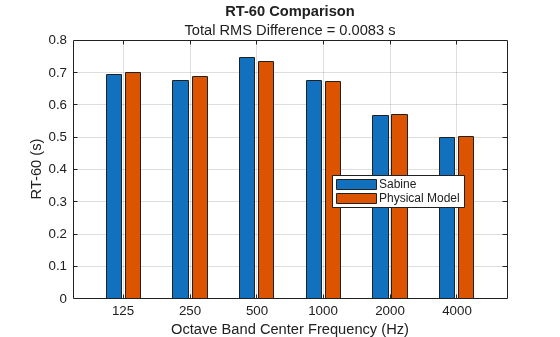
    0.69268    0.67454    0.74555    0.67551    0.56775    0.49966
Isolate the RT-60 values for later comparison.
t60_sabine = table2array(t60_sabine);
Next, use a physical modeling approach to simulate the room's impulse response and estimate the RT-60 from the simulated data.
Define a sampling frequency for the simulation.
fs = 24e3;
Define source and receiver positions for the simulation. The height, 1.55 m, is roughly ear level and a common choice. To reduce the dominance of early reflections and to avoid strong room modes, the positions are away from the walls and corners.
sourceloc = [2.1,2.3,1.55];
receiverloc = [7.0,4.9,1.55];
Use high scattering coefficients to simulate a diffuse acoustic field. Use the same six frequency-dependent scattering coefficients for all surfaces.
scatteringCoeffs = [0.8,0.5,0.5,0.5,0.5,0.5];
To simulate the impulse response using a hybrid image-source and ray-tracing algorithm, use acousticRoomResponse. Use the default parameters of the stochastic ray tracing algorithm (MaxNumRayReflections=10 and NumStochasticRays=1280) to model the reverberant tail. Increase the image-source order for a more accurate model of the sound reflections.
ir = acousticRoomResponse(roomdims,sourceloc,receiverloc, ...
    BandCenterFrequencies=[125,250,500,1000,2000,4000], ...
    AirAbsorption=0, ...
    MaterialAbsorption=alpha, ...
    MaterialScattering=scatteringCoeffs, ...
    Algorithm="hybrid", ...
    MaxNumRayReflections=10, ...
    NumStochasticRays=1280, ...
    ImageSourceOrder=45);
To simulate a realistic measurement, add a noise floor to the impulse response. The supporting function iAddNoiseFloor does this.
noiseFloor = -80; % dB
rir = iAddNoiseFloor(ir,fs,noiseFloor);
Estimate the RT-60 from the simulated room impulse response using T30. RT-60 is the time it takes to the energy of an impulse response to decrease 60 dB from its peak. However, actually achieving a 60 dB dynamic range in a measurement is unlikely due to noise floors in most real measurements. Generally, a 20 dB range or 30 dB range (T20 and T30, respectively) is measured and the slope is extrapolated to 60 dB.
t60 = rt60(rir,fs,FilterOrder=64);
t60_physicalmodel = t60.T30'
t60_physicalmodel = 1×6

    0.7005    0.6877    0.7331    0.6720    0.5700    0.5028
Compare the analytical (Sabine) and simulated (physical model) RT-60s by calculating their root mean square (RMS) difference. Display the RT-60 values and RMS difference.
rms_error = rms(t60_physicalmodel - t60_sabine);

figure
bar(["125","250","500","1000","2000","4000"],[t60_sabine(:),t60_physicalmodel(:)],"grouped");
xlabel("Octave Band Center Frequency (Hz)");
ylabel("RT-60 (s)");
legend("Sabine","Physical Model",Location="best");
title("RT-60 Comparison","Total RMS Difference = " + round(rms_error,4) + " s");
grid on
Invert the Sabine Equation: Find Absorption Coefficients from Target RT-60
Assume you want to design the room to achieve specific target RT-60 values in each frequency band.
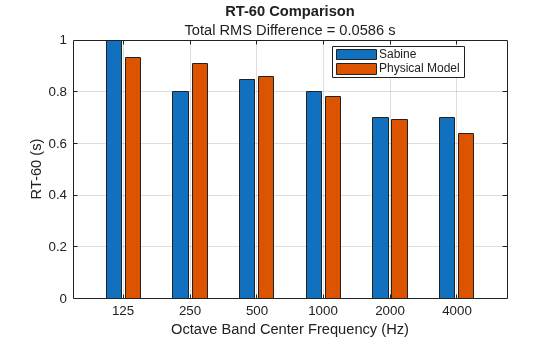
t60_target = [1,0.8,0.85,0.8,0.7,0.7];
Invert the Sabine equation to solve for the average absorption coefficient needed for each band. The supporting function iInverseRT60model does this.
alpha_target = iInverseRT60model(roomdims,t60_target)
alpha_target = 1×6

    0.1416    0.1770    0.1666    0.1770    0.2023    0.2023
Verify the resulting RT-60 values match the target values using the Sabine equation with the newly computed absorption coefficients.
t60_target_sabine = iRT60model(roomdims,alpha_target)
t60_target_sabine = 1×6

    1.0000    0.8000    0.8500    0.8000    0.7000    0.7000
Simulate the room again with these new absorption coefficients. Again, add a noise floor to simulate a realistic measurement.
ir = acousticRoomResponse(roomdims,sourceloc,receiverloc, ...
    BandCenterFrequencies=[125,250,500,1000,2000,4000], ...
    AirAbsorption=0, ...
    MaterialAbsorption=alpha_target, ...
    MaterialScattering=[0.8,0.5,0.5,0.5,0.5,0.5], ...
    Algorithm="hybrid", ...
    MaxNumRayReflections=10, ...
    NumStochasticRays=100, ...
    ImageSourceOrder=45);

noiseFloor = -80;
rir = iAddNoiseFloor(ir,fs,noiseFloor);
Estimate RT-60 from the simulated response.
t60 = rt60(rir,fs,FilterOrder=64);
t60_target_physicalmodel = t60.T30'
t60_target_physicalmodel = 1×6

    0.9325    0.9101    0.8583    0.7825    0.6921    0.6406
Compute the RMS error between the Sabine-predicted and simulated RT-60s and display the results.
rms_error = rms(t60_target_physicalmodel - t60_target_sabine);

figure
bar(["125","250","500","1000","2000","4000"],[t60_target_sabine(:),t60_target_physicalmodel(:)],"grouped");
xlabel("Octave Band Center Frequency (Hz)");
ylabel("RT-60 (s)");
legend("Sabine","Physical Model",Location="best");
title("RT-60 Comparison","Total RMS Difference = " + round(rms_error,4) + " s");
grid on
Supporting Functions
Add Noise Floor
function ir = iAddNoiseFloor(ir,fs,noiseFloor)
% Adds a pink noise floor to the impulse response to simulate measurement noise.

% Extend IR for ISO 3382 compliance (minimum 1.6 s duration)
flength = ceil(2*fs);

% Zero-pad IR to minimum length
if numel(ir) < flength
    ir = resize(ir(:),flength);
else
    ir = ir(:);
end

% Generate pink noise and normalize rms.
rng default
noise = pinknoise(numel(ir),1);
noise = noise./rms(noise);

% Scale pink noise to desired rms.
noise_rms = max(abs(ir(:))) * 10^(noiseFloor/20);
noise = noise*noise_rms;

ir = ir + noise;
end
RT-60 Model (Sabine)
function t60 = iRT60model(roomdims,alpha,options)
% Calculates RT-60 using the Sabine equation for a shoe-box room.
arguments
    roomdims
    alpha
    options.SoundSpeed (1,1) = 343 % (m/s)
end

Lx = roomdims(1); % Length
Ly = roomdims(2); % Width
Lz = roomdims(3); % Height

% Surface areas
Sxy = Lx*Ly;
Syx = Sxy;
Sxz = Lx*Lz;
Szx = Sxz;
Syz = Ly*Lz;
Szy = Syz;

S = [Sxy;Syx;Sxz;Szx;Syz;Szy];

% Total Volume
V = prod(roomdims);

% Compute the frequency-dependent effective absorbing area of the room surfaces.
A = sum(S.*alpha,1);

% Apply Sabine formula
t60 = (55.25/options.SoundSpeed)*V./A;
end
Inverse RT-60 Model (Sabine)
function alpha = iInverseRT60model(roomdims,t60,options)
% Inverts the Sabine equation to estimate the average absorption coefficient
% required to achieve a target RT-60 in each frequency band.
arguments
    roomdims
    t60
    options.SoundSpeed (1,1) = 343 % (m/s)
end

Lx = roomdims(1); % Length
Ly = roomdims(2); % Width
Lz = roomdims(3); % Height

% Surface areas
Sxy = Lx*Ly;
Syx = Sxy;
Sxz = Lx*Lz;
Szx = Sxz;
Syz = Ly*Lz;
Szy = Syz;

S = [Sxy;Syx;Sxz;Szx;Syz;Szy];

% Total Volume
V = prod(roomdims);

% Total surface area
Stot = sum(S);

% Invert Sabine formula:
alpha = (55.25/options.SoundSpeed).*V./ (Stot.*t60);
end
Input Arguments
Name-Value Arguments
Output Arguments
References
[1] IEC 61260-1:2014. "Electroacoustics — Octave-band and fractional-octave-band filters — Part 1: Specifications." International Electrotechnical Commission.
[2] ISO 3382-1:2009. "Acoustics — Measurement of room acoustic parameters — Part 1: Performance spaces." International Organization for Standardization.
[3] ISO 3382-2:2008. "Acoustics — Measurement of room acoustic parameters — Part 2: Reverberation time in ordinary rooms." International Organization for Standardization.
[4] Guski, Martin. Influences of External Error Sources on Measurements of Room Acoustic Parameters. Aachener Beiträge Zur Technischen Akustik, Band 24. Berlin: Logos Verlag Berlin GmbH, 2015.
Extended Capabilities
Version History
Introduced in R2025a

