pochhammer
R2026bPochhammer symbol
Syntax
Description
pochhammer(
returns the Pochhammer Symbol
(x)n.x,n)
Examples
Find Pochhammer Symbol for Numeric and Symbolic Inputs
Find the Pochhammer symbol for the numeric inputs x
= 3 at n = 2.
pochhammer(3,2)
ans =
    12
Find the Pochhammer symbol for the symbolic input x at
n = 3. The pochhammer function does not
automatically return the expanded form of the expression. Use
expand to force pochhammer to return
the form of the expanded expression.
syms x
P = pochhammer(x, 3)
P = expand(P)
P =
pochhammer(x, 3)
P =
x^3 + 3*x^2 + 2*x
Rewrite and Factor Outputs of Pochhammer
If conditions are satisfied, expand
rewrites the solution using gamma.
syms n x
assume(x>0)
assume(n>0)
P = pochhammer(x, n);
P = expand(P)
P =
gamma(n + x)/gamma(x)
To use the variables in further computations, clear their assumptions by
recreating them using syms.
syms n x
To convert expanded output of pochhammer into its factors,
use factor.
P = expand(pochhammer(x, 4));
P = factor(P)
P =
[ x, x + 3, x + 2, x + 1]
Differentiate Pochhammer Symbol
Differentiate pochhammer once with
respect to x.
syms n x
diff(pochhammer(x,n),x)
ans =
pochhammer(x, n)*(psi(n + x) - psi(x))
Differentiate pochhammer twice with respect to
n.
diff(pochhammer(x,n),n,2)
ans =
pochhammer(x, n)*psi(n + x)^2 + pochhammer(x, n)*psi(1, n + x)
Taylor Series Expansion of Pochhammer Symbol
Use taylor to find the Taylor series
expansion of pochhammer with n = 3
around the expansion point x = 2.
syms x
taylor(pochhammer(x,3),x,2)
ans =
26*x + 9*(x - 2)^2 + (x - 2)^3 - 28
Plot Pochhammer Symbol
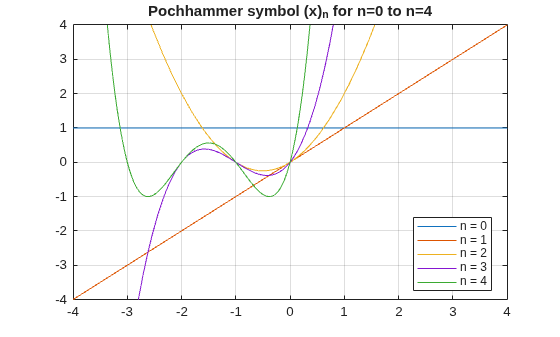
Plot the Pochhammer symbol from n = 0 to n = 4 for x. Use axis to display the region of interest.
syms x
fplot(pochhammer(x,0:4))
axis([-4 4 -4 4])

grid on
legend('n = 0','n = 1','n = 2','n = 3','n = 4','Location','Best')
title('Pochhammer symbol (x)_n for n=0 to n=4')
Input Arguments
More About
Algorithms
If
xandnare numerical values, then an explicit numerical result is returned. Otherwise, a symbolic function call is returned.If both
xandx + nare nonpositive integers, thenThe following special cases are implemented.
If
nis a positive integer, thenexpand(pochhammer(x,n))returns the expanded polynomial .If
nis not an integer, thenexpand(pochhammer(x,n))returns a representation in terms ofgamma.
Version History
Introduced in R2014b

