wsstridge
R2026bTime-frequency ridges from wavelet synchrosqueezing
Syntax
Description
fridge = wsstridge(sst)sst. The sst input is the
output of wsst using the analytic Morlet wavelet. Each ridge
is a separate signal mode.
If you used a wavelet other than the default Morlet wavelet ("amor") in
wsst, or a nondefault VoicesPerOctave value in
wsst, you can use the optional continuous wavelet transform (CWT) filter
bank parameters output from wsst and input that to
wsstridge using the FilterBankParameters name-value
argument. Alternatively, you can use the frequencies output of wsst
directly in wsstridge.
[___]= wsstridge(___,
returns the time-frequency ridge with additional options specified by one or more
Name=Value)Name=Value arguments.
Examples
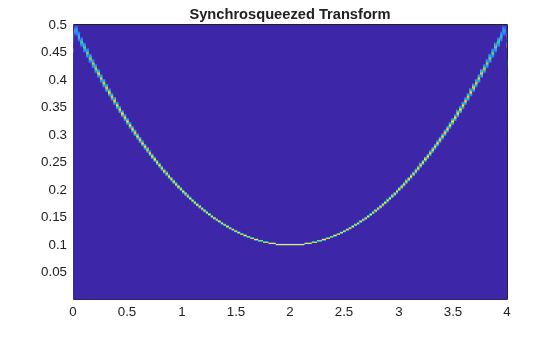
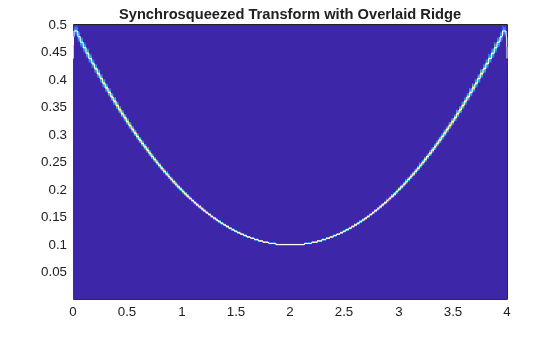
Obtain the wavelet synchrosqueezed transform of a quadratic chirp and extract the maximum time-frequency ridge, in fridge, and the associated row indices, in iridge.
Load the chirp signal and obtain its synchrosqueezed transform.
load quadchirp
[sst,f] = wsst(quadchirp);Extract the maximum time-frequency ridge.
[fridge,iridge] = wsstridge(sst);
Plot the synchrosqueezed transform.
pcolor(tquad,f,abs(sst))
shading interp
title("Synchrosqueezed Transform")
Overlay the plot of the maximum energy frequency ridge.
hold on
plot(tquad,fridge,"w")
hold off
title("Synchrosqueezed Transform with Overlaid Ridge")
Extract the two highest energy modes from a multicomponent signal using two methods:
Use the frequency vector output of the
wsstfunction.Use the CWT filter bank parameters output of
wsst.
Load a multicomponent signal. Obtain the CWT of the signal using the analytic Morlet wavelet.
load multicompsig
sig = sig1+sig2;
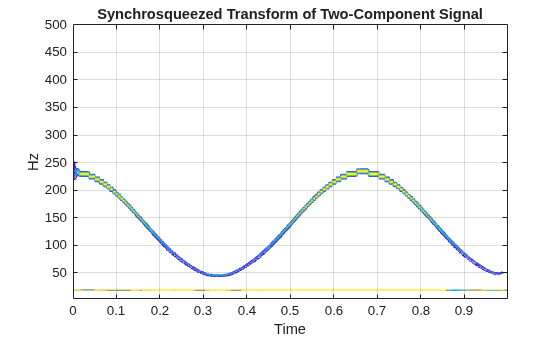
Method 1 — Frequency Vector
Obtain the wavelet synchrosqueezed transform of the signal. Also obtain the frequency vector output. Plot the output.
[sst,F] = wsst(sig,sampfreq);
contour(t,F,abs(sst))
xlabel("Time")
ylabel("Hz")
grid on
title("Synchrosqueezed Transform of Two-Component Signal")
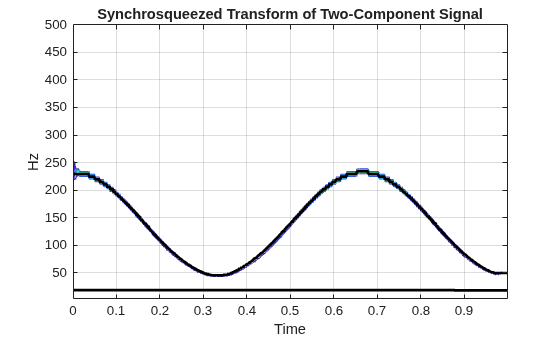
Using a penalty of 10, extract the two highest energy modes and plot the result.
[fridge,iridge] = wsstridge(sst,10,F,NumRidges=2);
hold on
plot(t,fridge,"k",LineWidth=2)
hold off
Method 2 — CWT Filter Bank Parameters
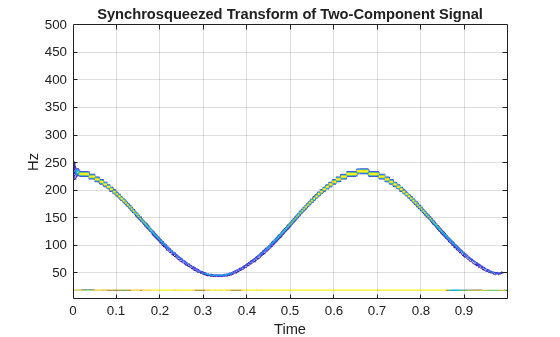
Obtain the wavelet synchrosqueezed transform of the signal. Also obtain the filter bank parameters. Plot the output.
[sst,~,fbparams] = wsst(sig,sampfreq);
contour(t,F,abs(sst))
xlabel("Time")
ylabel("Hz")
grid on
title("Synchrosqueezed Transform of Two-Component Signal")
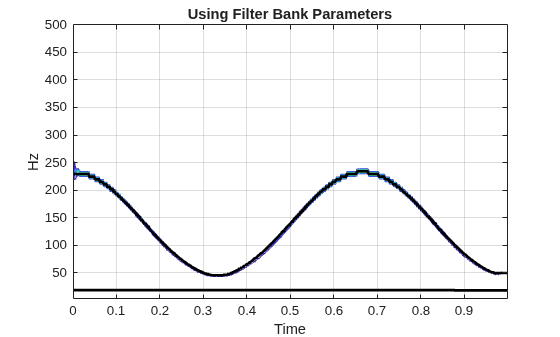
Using a penalty of 10, extract the two highest energy modes using the filter bank parameters. Plot the result.
[fridge,iridge] = wsstridge(sst,10,NumRidges=2, ...
    FilterbankParameters=fbparams);
contour(t,F,abs(sst))
xlabel("Time")
ylabel("Hz")
grid on
title("Using Filter Bank Parameters")
hold on
plot(t,fridge,"k",LineWidth=2)
hold off
Input Arguments
Name-Value Arguments
Output Arguments
Algorithms
The function uses a penalized forward-backward greedy algorithm to extract the maximum-energy
ridges from a time-frequency matrix. For unpenalized ridge extraction —where the penalty for
changing frequency is 0— the function instead selects the maximum energy at
each time point.
The penalized forward-backward greedy algorithm finds the maximum time-frequency ridge by minimizing –ln S at each time point. Minimizing –ln S is equivalent to maximizing the value of S. The algorithm optionally constrains jumps in frequency with a penalty that is proportional to the distance between frequency bins.
Assume a real-valued matrix E(j,i) = – ln(S(j,i)), where j = 1, 2, …, M indexes frequency bins and i = 1, 2, …, N indexes time bins. S can be, for instance, the absolute value of the Fourier or wavelet synchrosqueezed transform of a signal. The algorithm seeks a curve γ(i) that minimizes the quadratic regularized cost
,
where the first term enforces the curve to follow low-energy bins and the second term penalizes large frequency jumps. The parameter λ > 0 controls smoothness.
Let the state cost be F(j,i) = – ln(S(j,i)), which is the minimum total cost of all paths ending at bin j at time i. The algorithm performs these steps:
Initialization:
Recursion:
Backtracking:
The following example illustrates the time-frequency ridge algorithm using a penalty that is
two times the distance between frequency bins. Specifically, the distance between the elements
(j,k) and (m,n) is defined as
(j-m)2. The time-frequency matrix has three
frequency bins and three time steps. The matrix columns correspond to time steps, and the matrix
rows correspond to frequency bins. The values in the second row represent a sine wave.
Suppose you have the matrix:
1   4   4
2   2   2
5   5   4
Update the value for the (1,2) element as follows.
Leave the values at the first time point unaltered. Begin the algorithm with the (1,2) element of the matrix, which presents the first frequency bin at the second time point. The bin value is 4. Penalize the values in the first column based on their distance from the (1,2) element. Applying the penalty to the first column produces
The minimum value of theoriginalValues + penalty × distance = penalizedValues 1 + 2 × 0 = 1 2 + 2 × 1 = 4 5 + 2 × 4 = 13penalizedValuesvector is 1, which is from the frequency bin (row) 1.Note
If there are two or more rows containing the minimum value of the
penalizedValuesvector, the algorithm chooses the frequency bin with the highest row index that satisfies the minimum value criterion because the algorithm loops down the rows and updates the minimum as it goes. While ties are possible to occur in synthetic data, such ties are unlikely for data coming from real-world time-frequency data.Add the minimum value in column 1 to the current bin value, 4. The updated value for (1,2) becomes 5, which came from bin 1.
Update the values for the remaining elements in column 2 as follows.
Recompute the original column 1 values with the penalty factor using the same process as in Step 2a. Obtain the remaining second column values using the same process as in Step 2b. For example, when updating the (2,2) element, which has bin value 2, applying the penalty to the column yields
Add the minimum value, 2, to the current bin value. The updated value for (2,2) becomes 4. After updating the (3,2) element, the matrix isoriginalValues + penalty × distance = penalizedValues 1 + 2 × 1 = 3 2 + 2 × 0 = 2 5 + 2 × 1 = 7Only the second column has been updated. The subscripts indicate the index of the bin in the previous column from which a value came.1 5(1) 4 2 4(2) 2 5 9(2) 4
Repeat Step 2 for the third column. But now the penalty is applied to the updated second column. For example, when updating the (1,3) element, the penalized values are
The minimum value, 5, which is in the first bin, is added to the (1,3) bin value. After updating all the values in the third column, the final matrix is5 + 2 × 0 = 5 4 + 2 × 1 = 6 9 + 2 × 4 = 17
1   5(1)   9(1)
2   4(2)   6(2)
5   9(2)  10(2)
Starting at the last column of the matrix, find the minimum value. Walk back in time through the matrix by going from the current bin to the origin of that bin at the previous time point. Keep track of the bin indices, which form the path composing the ridge. The algorithm smooths the transition by using the origin bin instead of the bin with the minimum value. For this example, the ridge indices are
2,2,2, which match the energy path of the sine wave in row 2 of the matrix shown in Step 1.
If you are extracting multiple ridges, the algorithm removes the first ridge from the time-frequency matrix and repeats the process.
References
[1] Daubechies, I., J. Lu, and H.-T. Wu. "Synchrosqueezed wavelet transforms: an empirical mode decomposition-like tool." Applied and Computational Harmonic Analysis. Vol. 30, Number 2, 2011, pp. 243–261.
[2] Thakur, G., E. Brevdo, N. S. Fučkar, and H.-T. Wu. "The Synchrosqueezing algorithm for time-varying spectral analysis: Robustness properties and new paleoclimate applications." Signal Processing. Vol. 93, Number 4, 2013, pp. 1079–1094.

