calibrateMicrophone
R2026bCalibration factor for microphone
Syntax
Description
calibrationFactor = calibrateMicrophone(micRecording,fs,SPLreading)micRecording.
calibrationFactor = calibrateMicrophone(micRecording,fs,SPLreading,Name,Value)Name,Value pair arguments.
Example: calibrationFactor =
calibrateMicrophone(micRecording,fs,SPLreading,'FrequencyWeighting','Z-weighting')
returns the calibration factor for an SPL reading that applies Z-weighting.
Examples
This diagram depicts the setup used in the example:
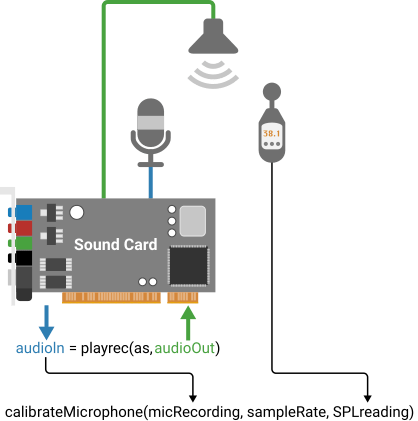
To run this example, you must connect a microphone and loudspeaker to a full-duplex sound card, and use an SPL meter to determine the true loudness level.
Create a 1 kHz sine wave at a sample rate of 48 kHz and a duration of 3 seconds.
fs = 48e3;
f0 = 1e3;
dur = 3;
t = (0:3*fs-1)'/fs;
tone = sin(2*pi*f0*t);
Create an audiostreamer object to write the sine wave to your loudspeaker and simultaneously read from your microphone.
streamer = audiostreamer(Mode="full-duplex",SampleRate=fs, ...
    PlayerChannels=1);
Play the 1 kHz sinusoid through your loudspeaker and simultaneously record audio from your microphone. While the tone plays, note the true SPL measurement as reported from your SPL meter.
micRecording = playrec(streamer,tone);
SPL = 78.2; % read from physical SPL meter
Compute the calibration factor for the microphone.
calibrationFactor = calibrateMicrophone(micRecording,fs,SPL);
The diagram depicts the example setup and data flow.
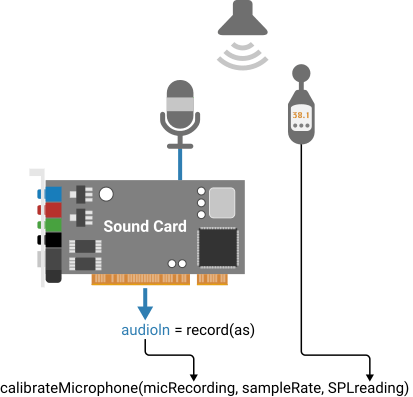
To run this example, you must connect a microphone to your audio card, generate a 1 kHz tone using an external device, and use an SPL meter to determine the true loudness level.
Specify a 48 kHz sample rate for your audio device and a 3-second duration for acquiring audio. Create an audiostreamer object to record from your audio device.
fs = 48e3;
dur = 3;

recorder = audiostreamer(Mode="recorder",SampleRate=fs);
Start the 1 kHz test tone using an external loudspeaker. Record from the microphone for the specified duration. While the recording runs, note the true SPL measurement as reported from your SPL meter.
record(recorder,dur*fs);
waitfor(recorder);

SPL = 77.7; % read from physical SPL meter

micRecording = read(recorder);
release(recorder);
Compute the calibration factor for the microphone.
calibrationFactor = calibrateMicrophone(micRecording,fs,SPL);
Input Arguments
Name-Value Arguments
Output Arguments
Algorithms
To determine the calibration factor for a microphone, the
calibrateMicrophone function uses:
A calibration tone recorded from the microphone you want to calibrate.
The sample rate used by your sound card for AD conversion.
The known loudness, usually determined using a physical SPL meter.
The frequency weighting used by your physical SPL meter.
The atmospheric pressure at the recording location.
The diagram indicates a typical physical setup and the locations of required information.
The calibrationFactor is set according to the equation:
where x is the microphone recording passed through the
weighting filter specified in the FrequencyWeighting argument.
k is 1 pascal relative to the PressureReference
calculated in dB:
Extended Capabilities
Version History
Introduced in R2020a
See Also
splMeter | acousticLoudness | acousticSharpness | acousticFluctuation | acousticRoughness

