im2col
R2026bRearrange image blocks into columns
Description
Examples
Input Arguments
Output Arguments
Algorithms
im2col first pads A, if needed, so the
size of the image is an integer multiple of
m-by-n. The padding value is
0 when A is of data type
uint8, uint16, or
logical. For other data types, the padding value is
1 when A is interpreted as an indexed
image, and 0 otherwise.
im2col then rearranges each
m-by-n block of the image or region into a
column in a temporary matrix. im2col orders the columns of
B so that they can be reshaped to form a matrix according
to the reshape function. The order of the
columns in matrix B is determined by traversing the image
A in a column-wise manner. For example, if
A consists of distinct blocks Aij
arranged as A = [A11 A12; A21 A22], then B = [A11(:)
A21(:) A12(:) A22(:)].
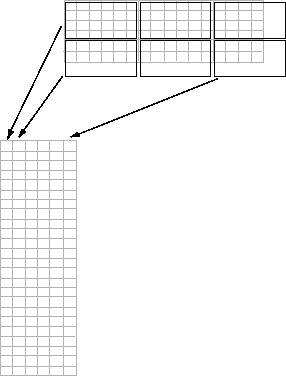
The following figure illustrates this process. A 6-by-16 image is processed in
4-by-6 blocks. im2col first zero-pads the image to make the
size 8-by-18 (six 4-by-6 blocks), and then rearranges the blocks into six columns of
24 elements each.
im2col rearranges each sliding
m-by-n neighborhood of the image into a
column in a temporary matrix. The temporary matrix has one column for each
neighborhood in the original image. The order of the columns in matrix
B is determined by traversing the image
A in a column-wise manner.
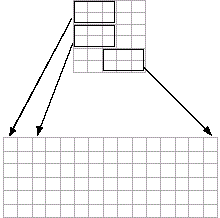
The following figure illustrates this process. In this figure, a small 6-by-5
pixel image is processed in 2-by-3 pixel neighborhoods. im2col
creates one column for each neighborhood in the image, so there are a total of 15
columns in the temporary matrix. Each pixel's column contains the value of the
pixels in its neighborhood, so there are six rows.
Version History
Introduced before R2006a

