movstd
R2026bMoving standard deviation
Syntax
Description
S = movstd(A,k)k-point standard deviation values. Each standard deviation is calculated over a
sliding window of length k across neighboring elements in
A. When k is odd, the window is centered
about the element in the current position. When k is even, the
window is centered about the current and previous elements. The window size is
automatically truncated at the endpoints when there are not enough elements to fill
the window. When the window is truncated, the standard deviation is calculated over
only the elements that fill the window. S is the same size as
A.
If
Ais a vector, thenmovstdoperates along the length of the vectorA.If
Ais a multidimensional array, thenmovstdoperates along the first dimension ofAwhose size is greater than 1.If
Ais a table or timetable, thenmovstdoperates along the variables ofA. (since R2025a)
S = movstd(___,w,dim)A to operate along for any of the
previous syntaxes. Always specify the weight w from the previous
syntax when specifying dim. For example,
movstd(A,k,0,2) operates along the columns of a matrix
A, computing the k-element sliding
standard deviation for each row. The normalization factor is the default,
k-1.
S = movstd(___,Name=Value)x is a time vector, then
movstd(A,k,SamplePoints=x) computes the moving standard
deviation relative to the times in x.
Examples
Input Arguments
Input data, specified as a vector, matrix, multidimensional array, table, or timetable.
Data Types: single | double | logical | table | timetable
Window length, specified as a numeric or duration scalar. When k is a
positive integer scalar, the centered standard deviation includes the
element in the current position plus surrounding neighbors.
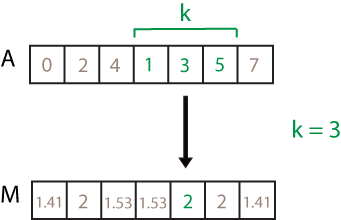
For example, M = movstd(A,3) computes an array of local
three-point standard deviation values.
Directional window length, specified as a numeric or duration two-element vector.
When kb and kf are nonnegative
integer scalars, the calculation is over kb+kf+1
elements. The calculation includes the element in the current position,
kb elements before the current position, and
kf elements after the current position.
For example, movstd(A,[2 1]) computes an array of local
four-point standard deviation values.
![movstd(A,[2 1]) computation. The elements in the sample window are 4, 1, 3, and 5, so the resulting local standard deviation is 1.71.](movstd_windowing.png)
Weight, specified as one of these values:
0— Normalize byk-1, wherekis the window length. Ifk=1, the weight isk.1— Normalize byk.
Data Types: single | double
Dimension to operate along, specified as a positive integer scalar. If you do not specify the dimension, then the default is the first array dimension whose size does not equal 1.
Dimension dim indicates the dimension that movstd operates
along, that is, the direction in which the specified window slides.
Consider an m-by-n input matrix,
A:
movstd(A,k,0,1)computes thek-element sliding standard deviation for each column ofAand returns anm-by-nmatrix.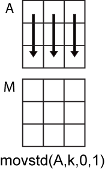
movstd(A,k,0,2)computes thek-element sliding standard deviation for each row ofAand returns anm-by-nmatrix.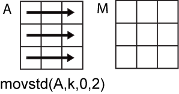
If A
is a table or timetable, then you cannot specify dim. The
movstd function always operates along the variables of tables and
timetables. (since R2025a)
Missing value condition, specified as one of these values:
"includemissing"or"includenan"— IncludeNaNvalues inAwhen computing each standard deviation. If any element in the window isNaN, then the corresponding element inSisNaN."includemissing"and"includenan"have the same behavior."omitmissing"or"omitnan"— IgnoreNaNvalues inA, and compute each standard deviation over fewer points. If all elements in the window areNaN, then the corresponding element inSisNaN."omitmissing"and"omitnan"have the same behavior.

