cheby1
R2026bChebyshev Type I filter design
Syntax
Description
[
designs a lowpass, highpass, bandpass, or bandstop digital Chebyshev Type I
filter, depending on the value of b,a] = cheby1(n,Rp,Wp,fType)fType and the number of
elements of Wp. The resulting bandpass and bandstop designs
are of order 2n.
Note
You might encounter numerical instabilities when designing IIR filters with transfer functions for orders as low as 4. See Transfer Functions and CTF for more information about numerical issues that affect forming the transfer function.
[
designs a digital Chebyshev Type I filter and returns its zeros, poles, and
gain. This syntax can include any of the input arguments in previous
syntaxes.z,p,k] = cheby1(___)
[___] = cheby1(___,"s") designs
an analog Chebyshev Type I filter using any of the input or output
arguments in previous syntaxes.
[
designs a lowpass digital Chebyshev Type I filter using second-order Cascaded Transfer Functions (CTF). The
function returns matrices that list the denominator and numerator polynomial
coefficients of the filter transfer function, represented as a cascade of filter
sections. This approach generates IIR filters with improved numerical stability
compared to single-section transfer functions. (since R2024b)B,A] = cheby1(n,Rp,Wp,"ctf")
[___] = cheby1(
designs a lowpass, highpass, bandpass, or bandstop digital Chebyshev Type I
filter, and returns the filter representation using the CTF format. The
resulting design sections are of order 2 (lowpass and highpass filters) or 4
(bandpass and bandstop filters). (since R2024b)n,Rp,Wp,fType,"ctf")
[___,
also returns the overall gain of the system. You must specify
gS] = cheby1(___)"ctf" to return gS. (since R2024b)
Examples
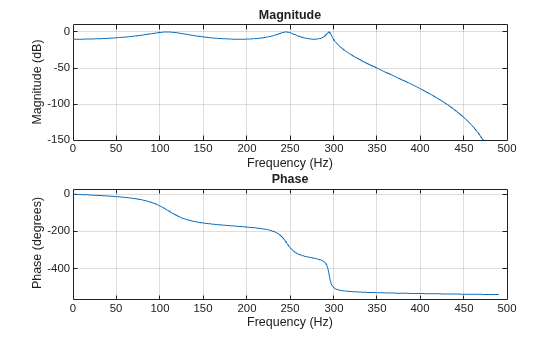
Design a 6th-order lowpass Chebyshev Type I filter with 10 dB of passband ripple and a passband edge frequency of 300 Hz, which, for data sampled at 1000 Hz, corresponds to rad/sample. Plot its magnitude and phase responses. Use it to filter a 1000-sample random signal.
fc = 300;
fs = 1000;

[b,a] = cheby1(6,10,fc/(fs/2));

freqz(b,a,[],fs)
dataIn = randn(1000,1);
dataOut = filter(b,a,dataIn);
Design a 6th-order Chebyshev Type I bandstop filter with normalized edge frequencies of and rad/sample and 5 dB of passband ripple. Plot its magnitude and phase responses. Use it to filter random data.
[b,a] = cheby1(3,5,[0.2 0.6],'stop');
freqz(b,a)
dataIn = randn(1000,1);
dataOut = filter(b,a,dataIn);
Design a 9th-order highpass Chebyshev Type I filter with 0.5 dB of passband ripple and a passband edge frequency of 300 Hz, which, for data sampled at 1000 Hz, corresponds to rad/sample. Convert the zeros, poles, and gain to second-order sections. Plot the magnitude and phase responses of the filter.
[z,p,k] = cheby1(9,0.5,300/500,'high');
sos = zp2sos(z,p,k);
freqz(sos)
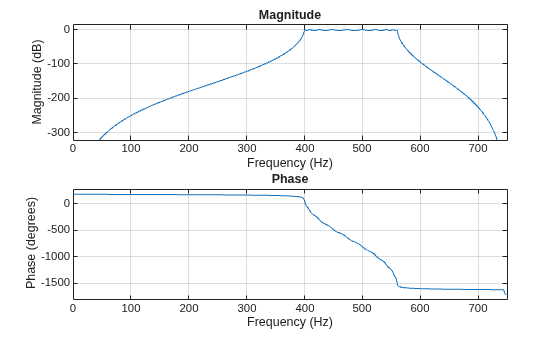
Design a 20th-order Chebyshev Type I bandpass filter with a lower passband frequency of 400 Hz and a higher passband frequency of 560 Hz. Specify a passband ripple of 3 dB and a sample rate of 1500 Hz. Use the state-space representation.
fs = 1500;

[A,B,C,D] = cheby1(10,3,[400 560]/(fs/2));
Convert the state-space representation to second-order sections and visualize the filter response.
sos = ss2sos(A,B,C,D);
freqz(sos,[],fs)
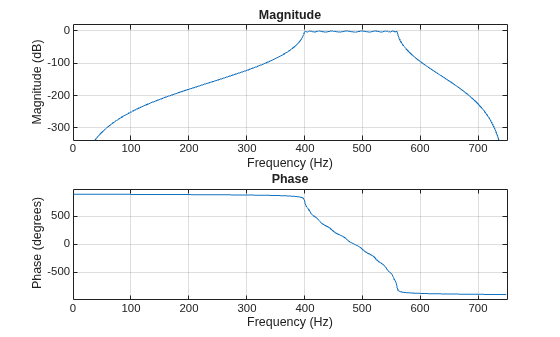
Design an identical filter using designfilt. Visualize the filter response.
d = designfilt("bandpassiir",FilterOrder=20, ...
    PassbandFrequency1=400,PassbandFrequency2=560, ...
    PassbandRipple=3,SampleRate=fs);
freqz(d,[],fs)
Design a fifth-order analog Butterworth lowpass filter with a cutoff frequency of 2 GHz. Multiply by to convert the frequency to radians per second. Compute the frequency response of the filter at 4096 points.
n = 5;
wn = 2*pi*2e9;
w = 2*pi*1e9*logspace(-2,1,4096)';

[zb,pb,kb] = butter(n,wn,"s");
[bb,ab] = zp2tf(zb,pb,kb);
[hb,wb] = freqs(bb,ab,w);
gdb = -diff(unwrap(angle(hb)))./diff(wb);
Design a fifth-order Chebyshev Type I filter with a passband edge frequency of 2 GHz and 3 dB of passband ripple. Compute its frequency response.
wp = wn;

[z1,p1,k1] = cheby1(n,3,wp,"s");
[b1,a1] = zp2tf(z1,p1,k1);
[h1,w1] = freqs(b1,a1,w);
gd1 = -diff(unwrap(angle(h1)))./diff(w1);
Design a fifth-order Chebyshev Type II filter with a stopband edge frequency of 2.5 GHz and 30 dB of stopband attenuation. Compute its frequency response.
ws = 2*pi*2.5e9;

[z2,p2,k2] = cheby2(n,30,ws,"s");
[b2,a2] = zp2tf(z2,p2,k2);
[h2,w2] = freqs(b2,a2,w);
gd2 = -diff(unwrap(angle(h2)))./diff(w2);
Design a fifth-order elliptic filter with the same passband and stopband edge frequencies, 3 dB of passband ripple, and 30 dB of stopband attenuation. Compute its frequency response.
[ze,pe,ke] = ellip(n,3,30,wp,"s");
[be,ae] = zp2tf(ze,pe,ke);
[he,we] = freqs(be,ae,w);
gde = -diff(unwrap(angle(he)))./diff(we);
Design a fifth-order Bessel filter with the same edge frequency. Compute its frequency response.
[zf,pf,kf] = besself(n,wn);
[bf,af] = zp2tf(zf,pf,kf);
[hf,wf] = freqs(bf,af,w);
gdf = -diff(unwrap(angle(hf)))./diff(wf);
Plot the attenuation in decibels. Express the frequency in gigahertz. Compare the filters.
fGHz = [wb w1 w2 we wf]/(2e9*pi);
plot(fGHz,mag2db(abs([hb h1 h2 he hf])))
axis([0 5 -45 5])
grid on
xlabel("Frequency (GHz)")
ylabel("Attenuation (dB)")
legend(["butter" "cheby1" "cheby2" "ellip" "besself"], ...
    Location="southwest")
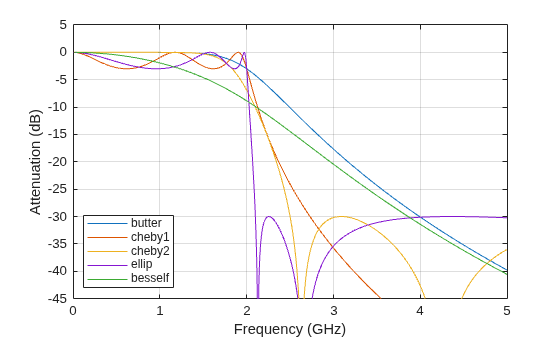
The Butterworth and Chebyshev Type II filters have flat passbands and wide transition bands. The Chebyshev Type I and elliptic filters roll off faster but have passband ripple. The frequency input to the Chebyshev Type II design function sets the beginning of the stopband rather than the end of the passband. Elliptic filters offer steeper rolloff characteristics than Butterworth and Chebyshev filters, but they are equiripple in both the passband and the stopband. Of these four classical filter types, elliptic filters usually meet a given set of filter performance specifications with the lowest filter order.
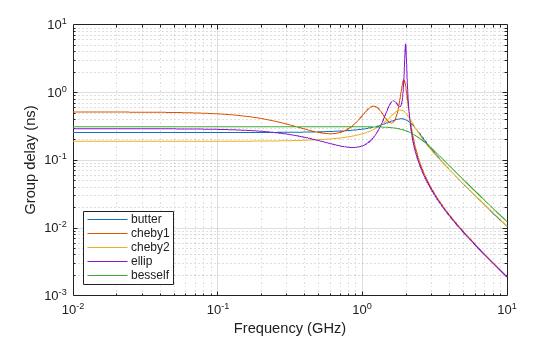
Plot the group delay in samples. Express the frequency in gigahertz and the group delay in nanoseconds. Compare the filters. The Bessel filter has approximately constant group delay along the passband.
gdns = [gdb gd1 gd2 gde gdf]*1e9;
gdns(gdns<0) = NaN;
loglog(fGHz(2:end,:),gdns)
grid on
xlabel("Frequency (GHz)")
ylabel("Group delay (ns)")
legend(["butter" "cheby1" "cheby2" "ellip" "besself"], ...
    Location="southwest")
Design a ninth-order highpass Chebyshev Type I filter with a cutoff frequency of 300 Hz and sampling rate of 1000 Hz. The passband ripple is 5 dB. Return the coefficients of the filter system as a cascade of second-order sections.
Wn = 300/(1000/2);
[B,A] = cheby1(9,5,Wn,"high","ctf")
B = 5×3

    0.1336   -0.1336         0
    0.1336   -0.2671    0.1336
    0.1336   -0.2671    0.1336
    0.1336   -0.2671    0.1336
    0.1336   -0.2671    0.1336
A = 5×3

    1.0000    0.9022         0
    1.0000    1.6117    0.8336
    1.0000    1.1993    0.8788
    1.0000    0.8296    0.9291
    1.0000    0.6335    0.9767
Plot the magnitude response of the filter.
filterAnalyzer(B,A)

Input Arguments
Output Arguments
More About
Numerical Instability of Transfer Function Syntax
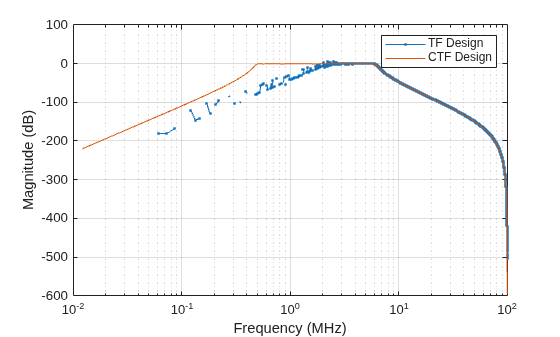
In general, use cascaded transfer functions ("ctf" syntaxes) to design IIR digital filters. If you design the filter using transfer functions (any of the [b,a] syntaxes), you might encounter numerical instabilities. These instabilities are due to round-off errors and can occur for an order n as low as 4. This example illustrates this limitation.
n = 6;
Rp = 0.6;
Fs = 200e6;
Wn = [0.5e6 6e6]/(Fs/2);
ftype = "bandpass";

% Transfer Function (TF) design
[b,a] = cheby1(n,Rp,Wn,ftype); % This is an unstable filter

% CTF design
[B,A] = cheby1(n,Rp,Wn,ftype,"ctf");

% Compare frequency responses
[hTF,f] = freqz(b,a,8192,Fs);
hCTF = freqz(B,A,8192,Fs);

semilogx(f/1e6,db(hTF),".-",f/1e6,db(hCTF))
grid on
legend(["TF Design" "CTF Design"])
xlabel("Frequency (MHz)")
ylabel("Magnitude (dB)")
Algorithms
Chebyshev Type I filters are equiripple in the passband and monotonic in the stopband. Type I filters roll off faster than Type II filters, but at the expense of greater deviation from unity in the passband.
The cheby1 function uses this algorithm:
It finds the lowpass analog prototype poles, zeros, and gain using the function
cheb1ap.It converts the poles, zeros, and gain into state-space form.
When designing digital filters, it prewarps the specified digital frequency
Wpto the corresponding analog frequencies.If required, it uses a state-space transformation to convert the lowpass filter to a highpass, bandpass, or bandstop filter with the desired frequency constraints.
When designing digital filters, it uses
bilinearto convert the analog filter into a digital filter through a bilinear transformation.It converts the state-space filter back to the transfer-function or zero-pole-gain form, as required.

