Simulink.sdi.setCursorPositions
R2026bSpecify active cursor positions in the Simulation Data Inspector
Description
Simulink.sdi.setCursorPositions(
configures the position for active cursors on all Simulation Data Inspector tabs as specified by
one or more name-value arguments.Name=Value)
Examples
You can use the Simulation Data Inspector programmatic interface to specify the position of cursors on time plots or sparklines and to access the time that corresponds to the current cursor position.
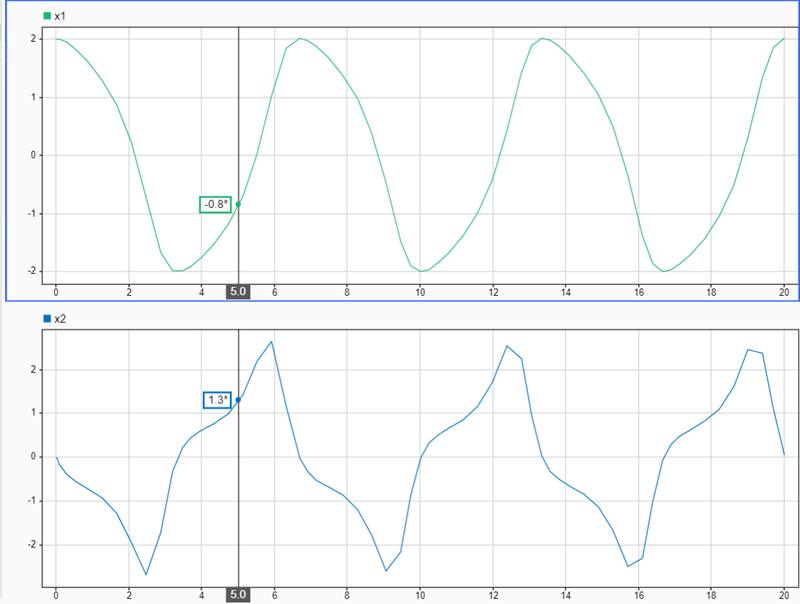
Suppose you want to know the signal values 5 seconds into
the simulation. Use the Simulink.sdi.setCursorPositions
function to move the cursor to 5 on the time axis and read
the signal values from the cursor on each subplot. The asterisk next to the
value in the cursor label indicates that the value is interpolated because the
simulation did not include a calculation for a simulation time of exactly
5 seconds.
Simulink.sdi.setCursorPositions(Left=5);
Suppose you want to calculate the time between two peaks in the
x2 signal. Add a second cursor using the
Simulink.sdi.setNumCursors function or by using
Show/hide data cursors  in the Simulation Data Inspector.
Simulink.sdi.setNumCursors(2);
Drag the cursors so the left cursor is positioned at the first peak in the
x2 signal and the right cursor is positioned at the
second peak. Alternatively, you can run this code that positions the cursors for
you.
Simulink.sdi.setCursorPositions(Left=5.921998549931304,...
    Right=12.378442136906246);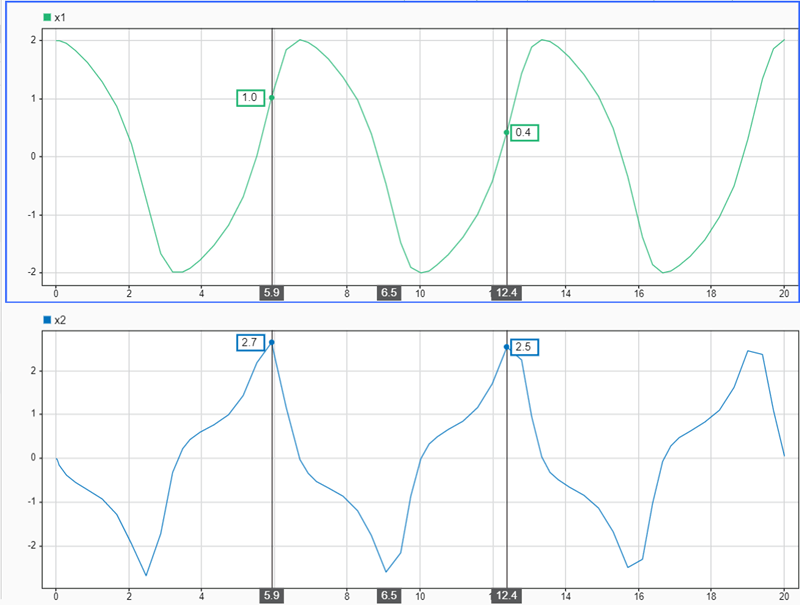
The Simulation Data Inspector displays the difference between the two cursors
in seconds. However, the cursor position and difference values are both rounded.
Use the Simulink.sdi.getCursorPositions function to
programmatically retrieve the exact time values that correspond to the cursor
positions. Then, compute the difference between the times.
[t1,t2] = Simulink.sdi.getCursorPositions;
T = t2 - t1
T = 6.4564
Name-Value Arguments
Version History
Introduced in R2021a

