Main Content

Double-Acting Actuator (G-IL)

R2026b

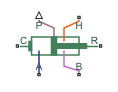
Linear actuator with isothermal liquid and gas chambers

  • Double-Acting Actuator (G-IL) block

Libraries:
Simscape / Fluids / Isothermal Liquid / Actuators

Description

The Double-Acting Actuator (G-IL) block represents an isothermal liquid chamber and a gas chamber separated by a piston plate. The piston actuation is controlled by the pressure differential between the chambers. The motion of the piston when it is near full extension or full retraction is limited by one of four hard stop models.

Port A is the isothermal liquid inlet and port B is the gas inlet. Connect elements for heat transfer between the gas chamber and the environment to port H. Port C acts as a mechanical translational reference for the actuator casing. Port R is associated with the actuator piston. The piston position is reported at port P.

This diagram shows the block behavior when Mechanical Orientation is Pressure at A causes positive displacement of R relative to C.
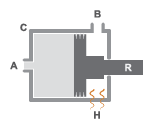
Double-Acting Actuator Schematic

Displacement

The piston displacement is measured as the position at port R relative to port C. The Mechanical orientation identifies the direction of piston displacement. The piston displacement is neutral, or 0, when the chamber volume is equal to the chamber dead volume. When displacement is received as an input, ensure that the derivative of the position is equal to the piston velocity. This is automatically the case when the input is received from a Translational Multibody Interface block connection to a Simscape™ Multibody™ joint.

Hard Stop Model

To avoid mechanical damage to the piston when it is fully extended or fully retracted, an actuator typically displays nonlinear behavior when the piston approaches these limits. The Double-Acting Actuator (G-IL) block models this behavior with a choice of four hard stop models, which model the material compliance through a spring-damper system. The hard stop models are:

  • Stiffness and damping applied smoothly through transition region, damped rebound.

  • Full stiffness and damping applied at bounds, undamped rebound.

  • Full stiffness and damping applied at bounds, damped rebound.

  • Based on coefficient of restitution

The hard stop force is modeled when the piston is at its upper or lower bound. The boundary region is within the Transition region of the Piston stroke or piston initial displacement. Outside of this region, FHardStop=0.

For more information about these settings, see the Translational Hard Stop block page.

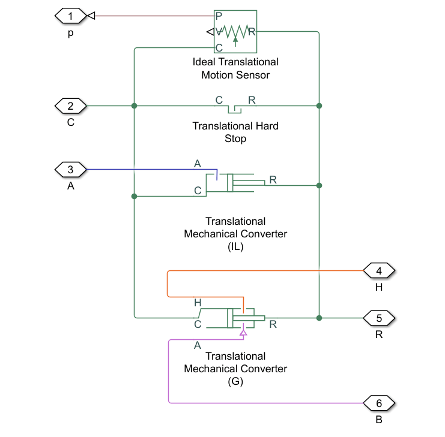
Block Schematic

The Double-Acting Actuator (G-IL) block is a composite of four Simscape Foundation blocks:
Examples

expand all

This example shows how to use a Double-Acting Actuator (G-IL) block to represent a double-acting actuator that implements an isothermal liquid port and gas port to control piston movement.

Examine the Model

Open the model.
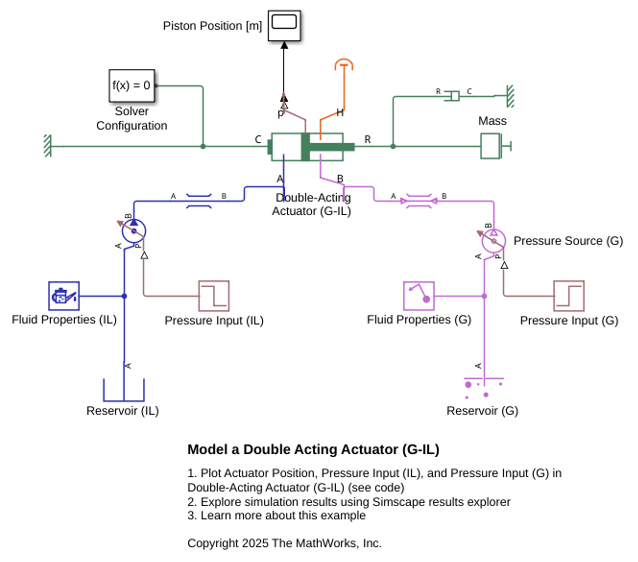
In the model, the Pressure Source (IL) block represents the pressure applied to the isothermal liquid side of the piston within the actuator cylinder. The Pressure Source (G) block represents the pressure applied to the gas side of the piston within the actuator cylinder. The Mass block represents a 1kg mass moved by the piston.

The Double-Acting Actuator (G-IL) block receives input from the Pressure Source (IL) block from time T = 0 to T = 30 seconds, which causes a positive displacement of the piston. The Double-Acting Actuator (G-IL) block then receives input from the Pressure Source (G) block from time T = 30 to T = 60 seconds, which causes a negative displacement of the piston.

You can adjust the pressure input values by modifying the parameters in the Pressure Input (IL) and Pressure Input (G) blocks.

Simulate the Model

The Piston Position [m] block plots the measured piston position over time.
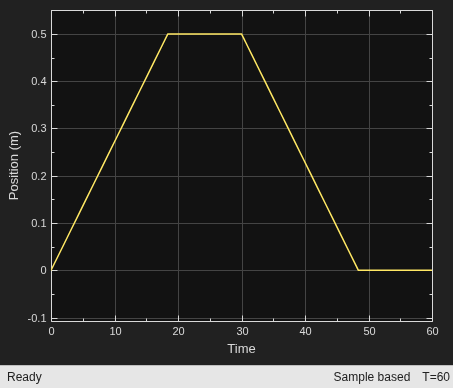
Observe that positive and negative piston displacements are limited by hardstops at 0.5 m and 0 m, respectively.

Ports

Output

expand all

Physical signal port associated with the piston position.

Programmatic Use

Port: p_out

Conserving

expand all

Isothermal liquid conserving port associated with the inlet to chamber A.

Programmatic Use

Port: A

Gas conserving port associated with the inlet to chamber B.

Programmatic Use

Port: B

Mechanical translational conserving port associated with the case.

Programmatic Use

Port: C

Mechanical translational conserving port associated with the piston rod.

Programmatic Use

Port: R

Thermal conserving port associated with heat transfer to or from the gas chamber.

Programmatic Use

Port: H

Parameters

expand all

Configuration

Piston displacement direction. Pressure at A causes positive displacement of R relative to C corresponds to piston extension when the pressure difference between chambers A and B is positive. Pressure at A causes negative displacement of R relative to C corresponds to piston retraction when the pressure difference between chambers A and B is positive.

Programmatic Use

Parameter: mech_orientation
Values: "foundation.enum.MechOrientationTranslational.Positive" | "foundation.enum.MechOrientationTranslational.Negative"

Maximum piston travel distance.

Programmatic Use

Parameter: stroke

Piston position at the start of the simulation.

Programmatic Use

Parameter: x0

Model choice for the force on the piston at full extension or full retraction. See the Translational Hard Stop block for more information.

Programmatic Use

Parameter: hardstop_model
Values: "simscape.enum.hardstop.smooth" | "simscape.enum.hardstop.fullundamped" | "simscape.enum.hardstop.fulldamped" | "simscape.enum.hardstop.modechart"

Piston stiffness coefficient.

Dependencies

To enable this parameter, set Hard stop model to

  • Stiffness and damping applied smoothly through transition region, damped rebound

  • Full stiffness and damping applied at bounds, undamped rebound

  • Full stiffness and damping applied at bounds, damped rebound

Programmatic Use

Parameter: stiff_coeff

Piston damping coefficient.

Dependencies

To enable this parameter, set Hard stop model to

  • Stiffness and damping applied smoothly through transition region, damped rebound

  • Full stiffness and damping applied at bounds, undamped rebound

  • Full stiffness and damping applied at bounds, damped rebound

Programmatic Use

Parameter: damping_coeff

Application range of the hard stop force model. Outside of this range of the piston maximum extension and piston maximum retraction, the Hard stop model is not applied and there is no additional force on the piston.

Dependencies

To enable this parameter, set Hard stop model to Stiffness and damping applied smoothly through transition region, damped rebound.

Programmatic Use

Parameter: transition

Ratio of the final to the initial relative speed between the slider and the stop after the slider bounces.

Dependencies

To enable this parameter, set Hard stop model to Based on coefficient of restitution.

Programmatic Use

Parameter: coeff_rest

Threshold relative speed between slider and stop before collision. When the slider hits the case with speed less than the value of the Static contact speed threshold parameter, they stay in contact. Otherwise, the slider bounces. To avoid modeling static contact between the slider and the case, set this parameter to 0.

Dependencies

To enable this parameter, set Hard stop model to Based on coefficient of restitution.

Programmatic Use

Parameter: v_tol

Minimum force needed to release the slider from a static contact mode.

Dependencies

To enable this parameter, set Hard stop model to Based on coefficient of restitution.

Programmatic Use

Parameter: f_tol

Isothermal Liquid Side

Cross-sectional area of the piston rod in chamber A.

Programmatic Use

Parameter: piston_area_A

Volume of moist air when the piston displacement is 0 in chamber A. This parameter is the moist air volume when the piston is against the actuator end cap.

Programmatic Use

Parameter: dead_volume_A

Whether to model any change in fluid density due to fluid compressibility. When Fluid compressibility is set to On, changes due to the mass flow rate into the block are calculated in addition to density changes due to changes in pressure. In the Isothermal Liquid Library, all blocks calculate density as a function of pressure.

Programmatic Use

Parameter: dynamic_compressibility
Values: "true" | "false"

Initial liquid pressure for compressible fluids.

Dependencies

To enable this parameter, select Enable dynamic compressibility.

Programmatic Use

Parameter: p0_A

Liquid pressure at nominal operating conditions in chamber A. The block uses this value to calculate the nominal density to use in the mass conservation equation when dynamic compressibility is disabled.

Dependencies

To enable this parameter, clear the Enable dynamic compressibility checkbox.

Programmatic Use

Parameter: p_nominal_A

Environment reference pressure. The Atmospheric pressure option sets the environmental pressure to 0.101325 MPa.

Programmatic Use

Parameter: environment_spec_A
Values: "foundation.enum.pressure_spec.atmospheric" | "foundation.enum.pressure_spec.specified"

User-defined environmental pressure.

Dependencies

To enable this parameter, set Environment pressure specification to Specified pressure.

Programmatic Use

Parameter: environment_p_A

Gas Side

Cross-sectional area of the piston rod in chamber B.

Programmatic Use

Parameter: piston_area_B

Cross-sectional area at port B.

Programmatic Use

Parameter: area_B

Volume of moist air when the piston displacement is 0 in chamber B. This parameter is the moist air volume when the piston is against the actuator end cap.

Programmatic Use

Parameter: dead_volume_B

Initial pressure in the gas chamber.

Programmatic Use

Parameter: p0_B

Initial temperature in the gas chamber.

Programmatic Use

Parameter: T0_B

Environment reference pressure. The Atmospheric pressure option sets the environmental pressure to 0.101325 MPa.

Programmatic Use

Parameter: environment_spec_B
Values: "foundation.enum.pressure_spec.atmospheric" | "foundation.enum.pressure_spec.specified"

User-defined environmental pressure.

Dependencies

To enable this parameter, set Environment pressure specification to Specified pressure.

Programmatic Use

Parameter: environment_p_B

Extended Capabilities

expand all

C/C++ Code Generation
Generate C and C++ code using Simulink® Coder™.

Version History

Introduced in R2020a

expand all